
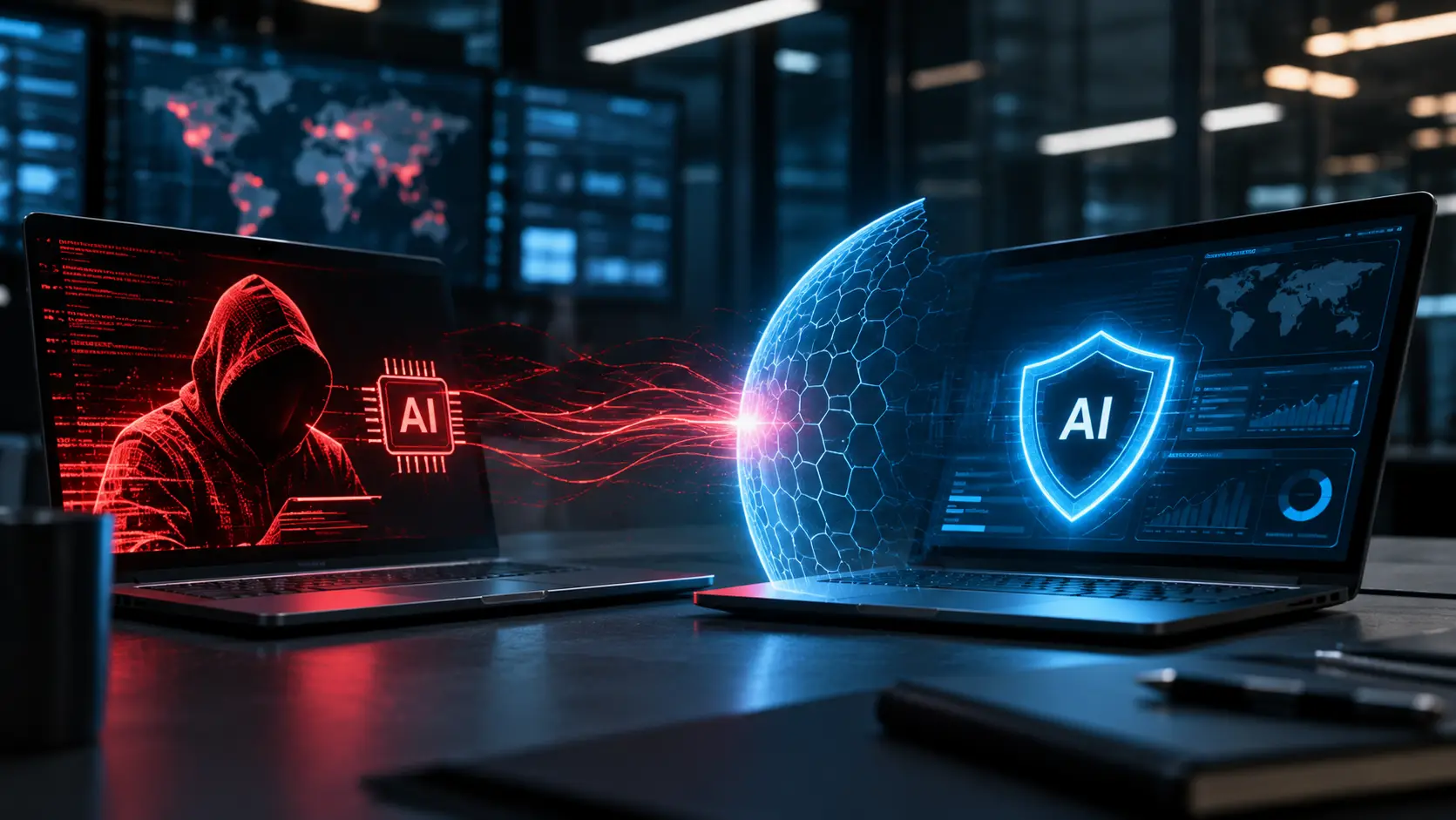

Japan Shows What Machine-Speed Pressure Looks Like
You don’t have to look far to see the pressure organizations are under. Japan reportedly logged 86 cyber incidents in September 2026, with SoftBank, Daiwa Securities and Lawson among those hit. Large financial groups like SBI Holdings, which runs more than 600 subsidiaries, have openly named AI-driven, blended attacks as a reason to rethink detection and adopt Zero Trust.
To be clear, these organizations aren’t being hit because of one AI breakthrough. They are a preview of what happens when sprawling, high-value environments face adversaries who can work at machine speed. And the technology behind that shift is no longer theoretical. In one documented campaign, Anthropic estimated that AI performed 80 to 90 percent of the tactical work, with humans stepping in at only a handful of decision points.
1. From Assistant to Autonomous Operator
Not long ago, attackers mainly used AI to brainstorm malware, polish phishing emails or assist with research. A human still did the work.
It helps to separate three stages, because they often get blurred together:
- AI-assisted: AI helps with content and ideas, such as phishing text, code snippets and research.
- AI-augmented: AI plans the attack, writes tooling and scales routine techniques across many targets.
- Agentic: AI can plan, act, adapt and retry through connected tools, while humans provide limited direction or approve key decisions.
The third stage is now emerging. Check Point’s 2026 research describes AI moving from an assistant toward a live attack operator, while noting that AI does not yet drive the majority of attacks worldwide.
What has changed is time. Autonomous systems can analyse reconnaissance data, test paths and perform repetitive attack tasks far faster than a human team. That means a security posture designed around human-speed detection and response can leave a wider window for an adversary to exploit.
2. The Evidence: What Has Actually Happened
Four documented cases show different forms of AI-assisted and agentic offensive activity.
GTG-1002: The Clearest Agentic Example
Who: Anthropic assessed the group, with high confidence, as Chinese state-sponsored. The activity was detected in September 2025 and disclosed on November 13, 2025.
Why: Espionage. The group targeted roughly 30 organizations, including technology companies, financial institutions, chemical manufacturers and government agencies.
How: Human operators selected targets and built an attack framework around Claude Code and common open-source penetration-testing tools. They broke the operation into smaller tasks and attempted to bypass model safeguards. Anthropic estimated that AI performed 80 to 90 percent of the campaign, with humans intervening at roughly four to six critical decision points.
Outcome: Only a small number of targets were successfully breached, and the AI sometimes invented credentials or misidentified public information as secret.
The lesson: agentic systems can perform large amounts of work at machine speed, but they remain fallible.
The FortiGate Campaign: AI-Augmented, at Scale
Who: Amazon Threat Intelligence attributed the activity to a financially motivated, Russian-speaking actor.
Why: Financial gain. The focus on internal networks and backup infrastructure was consistent with preparation for ransomware activity.
How: Between January 11 and February 18, 2026, the actor compromised more than 600 FortiGate devices across more than 55 countries. No FortiGate vulnerability was exploited. Exposed management interfaces and weak, single-factor credentials were enough; AI-assisted tooling helped parse configurations, map networks and automate reconnaissance.
Outcome: AI gave a relatively low-skilled actor the efficiency and scale that would previously have required a larger team.
The lesson: AI can make ordinary security weaknesses far more exploitable at scale.
AI as an Exploit Developer: An AI-Assisted Zero-Day
Who: Google Threat Intelligence Group (GTIG) reported activity involving a prominent cybercrime group but did not name the group, the AI model or the affected product.
Why: The group was preparing for a mass exploitation campaign and apparently already had valid credentials that could be used to bypass part of the target’s authentication process.
How: GTIG identified a previously unknown two-factor-authentication bypass in a popular open-source web administration tool. The flaw resulted from a hardcoded trust assumption and required valid credentials. GTIG assessed with high confidence that an AI model helped discover and weaponize it, although it did not believe Gemini was used.
Outcome: GTIG disclosed the vulnerability to the vendor and helped disrupt the planned exploitation activity.
AI is therefore not only helping execute attacks; it can also accelerate vulnerability research and exploit development.
PromptSpy: Malware That Asks an AI What to Do Next
Who: The operators are unknown. ESET found language and distribution clues suggesting a Chinese-speaking development environment and apparent targeting of Spanish-speaking users in Argentina.
Why: Spyware and fraud. PromptSpy disguises itself as a banking application and includes remote-access capabilities.
How: The malware sends information about the phone’s screen to Google’s Gemini model, which provides instructions for gestures that keep the malicious application pinned and harder to remove.
The caveat: ESET says the AI component is limited to part of the malware’s persistence mechanism and that PromptSpy had not appeared in its telemetry, meaning it may represent a proof of concept rather than a widespread threat.
Across the cases, the common thread is speed, scale and persistence.
3. Why Defenses Break, and the New Attack Surface
There are two halves to this problem: existing gaps that AI can exploit faster, and new weaknesses created by autonomous agents.
The speed mismatch. An autonomous attacker does not tire or wait for a shift change. A defense process that depends heavily on manual triage and response may operate on a slower clock than the attack.
Exposure gaps. The FortiGate campaign is fundamentally an exposure story: internet-facing management interfaces and weak credentials gave an AI-augmented actor an opening. Without continuous visibility into what is exposed and exploitable, defenders may discover weaknesses only after an attacker has found them. This is where Continuous Threat Exposure Management (CTEM) becomes relevant.
Supply chain and code. Compromised components, agent skills and connected tooling can become new paths into an organization, increasing the importance of software composition analysis (SCA) and supply-chain visibility.
Agents as the attack surface. AI agents can hold credentials, access authenticated sessions and interact with production systems. Their permissions, tools and integrations therefore become part of the security boundary. This calls for dedicated AI security.
Data as the payoff. Once an attacker gets inside, data is often the objective. Security architecture therefore has to assume the perimeter will be tested.
Organizations therefore need security controls and response processes capable of operating at a much faster tempo.
4. Building a Resilient Architecture with Pelorus
The goal is not simply to prevent every intrusion. It is to build an environment resilient enough that a machine-speed attack cannot easily turn one weakness into a business-wide compromise. At Pelorus, the security architecture can be mapped to these gaps:
| Security gap | Relevant capability |
|---|---|
| Exposure found before it can be fixed | CTEM |
| Compromised dependencies and agent ecosystems | SCA |
| Hijackable internal AI agents | AI security |
| Data as the final target | Data security |
| Human-speed detection and response | AI-driven SOC (SIEM, UEBA, SOAR) |
The order matters. Fix exposure first, protect agents and data, then strengthen detection, investigation and response so the time between detection and containment can shrink.
The Takeaway
Agentic AI is compressing the attack timeline. The answer is not to remove humans from cybersecurity; it is to give defenders the same advantage in speed while keeping human judgement where it matters.
Organizations that continuously reduce exposure, govern their AI agents, protect sensitive data and connect threat intelligence with faster detection and response will be better positioned for a threat environment in which attackers can increasingly operate at machine speed.
About Pelorus
Pelorus is a technology company focused on digital forensics, intelligence, surveillance and cybersecurity solutions for governments, law enforcement agencies and organizations operating in complex security environments.
Through specialized technologies, strategic partnerships and investigative expertise, Pelorus helps organizations strengthen cybersecurity operations, improve threat visibility, investigate digital activity and respond to evolving security challenges.
Its cybersecurity capabilities span areas including threat intelligence, security operations, detection and response, data security and other technologies designed to help organizations identify, understand and respond to complex cyber threats.
As cyber threats become increasingly automated and machine-driven, Pelorus works with organizations to strengthen the visibility, intelligence and security capabilities needed to respond with greater speed and confidence.
Sources
- CERT-In Advisory CIAD-2026-0049: AI Agents as Attack Vectors: Unauthorized Access by Agents under Evaluation and Misuse of Open-Source Agentic AI Tools Targeting Indian ICT Assets, October 15, 2026.
- Anthropic: Disrupting the First Reported AI-Orchestrated Cyber Espionage Campaign, November 13, 2025.
- Amazon Threat Intelligence / AWS Security Blog: AI-Augmented Threat Actor Accesses FortiGate Devices at Scale, February 2026.
- Google Threat Intelligence Group: GTIG AI Threat Tracker: Adversaries Leverage AI for Vulnerability Exploitation, Augmented Operations, and Initial Access, May 11, 2026.
- ESET Research: PromptSpy, the First Android Threat to Use Generative AI, February 2026.
- Check Point Research: AI Security Report 2026.
- Akamai: SBI Holdings Strengthened Ransomware Defense.