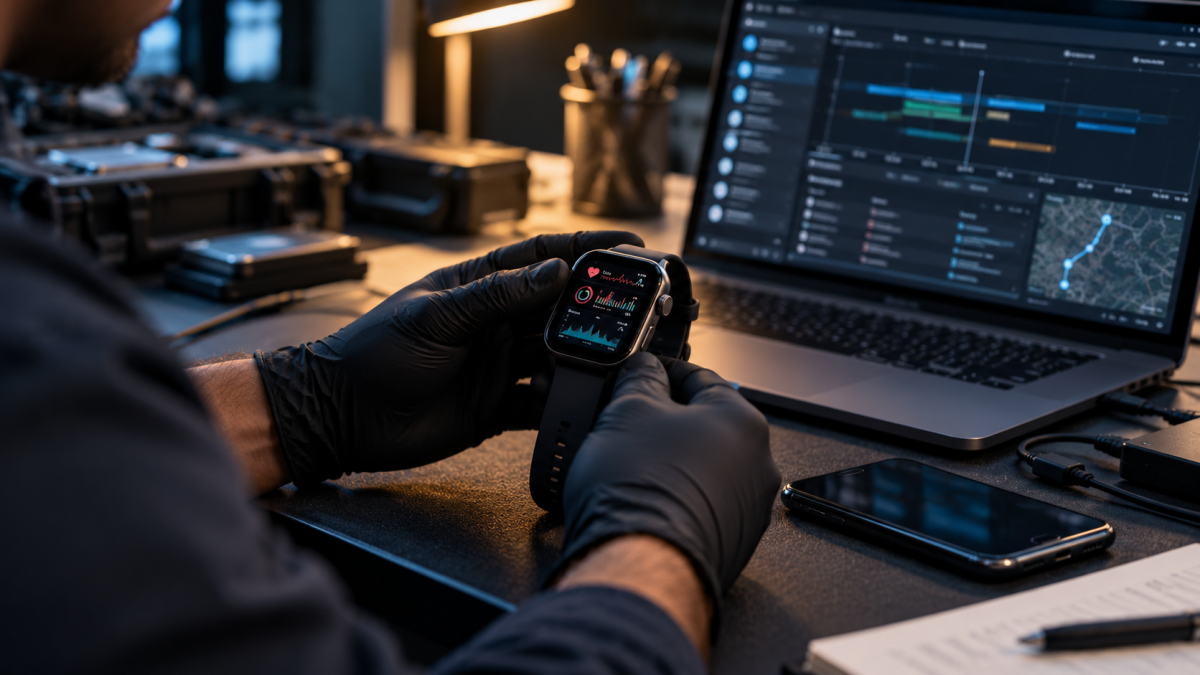

Smartwatches can record information throughout the day and night, creating a digital record of activity that may become relevant to an investigation. Depending on the device, this can include health and activity measurements, sleep information, location data, notifications, application data and device metadata.
Smartwatch forensics is the process of acquiring, analysing and reporting data from smartwatches and other wearable devices in a forensically sound manner. Because the available evidence varies considerably between devices, investigators need to understand both what a particular watch can provide and how that information should be interpreted.
Key Takeaways
- Smartwatches can contain health, activity, sleep, location and application-related evidence.
- Notifications and communication-related artefacts may provide additional context where supported.
- The paired smartphone can contain complementary or additional evidence from the same period.
- Extraction methods and available data vary by manufacturer, model, operating system, security state and forensic tool.
- Sensor readings and timestamps require context and should be corroborated with other evidence where possible.
Why Smartwatches Matter in Digital Investigations
A smartwatch is often worn continuously, which can make its data useful when investigators are reconstructing activity around a particular event. Depending on the device and available data, an examiner may be able to examine records relating to movement, exercise, sleep, heart rate, location or application activity.
The value becomes greater when smartwatch evidence is examined alongside other sources. A timestamp from a watch can potentially be compared with phone activity, messages, application records, CCTV or other evidence to determine whether different sources support the same sequence of events.
For a broader understanding of how mobile devices contribute to investigations, see our article on the role of mobile devices in digital forensics investigations.
What Data Can Investigators Extract from a Smartwatch?
The exact evidence available depends on the manufacturer, model, operating system, device configuration, synchronisation and forensic acquisition method. Depending on those factors, relevant evidence may include:
- Health data: heart rate and other supported health measurements.
- Sleep data: sleep periods and related activity records where supported.
- Activity data: steps, workouts, movement and exercise records.
- Location data: GPS or other location-related records where the device records them.
- Communication artefacts: notifications, calls or message-related information where supported by the device and extraction method.
- Application data: records generated by applications installed on the watch or synchronised through its companion ecosystem.
- Device metadata: timestamps, device information and other technical records that can help establish context.
Forensic software presents available records for examination. It does not automatically determine what a health measurement, sensor reading or behavioural pattern means. That interpretation remains the responsibility of the examiner.
How Smartwatch Forensics Works
Smartwatch forensic examination generally involves acquisition, analysis and reporting. The precise procedure depends on the device and the tools available.
1. Document and Preserve the Device
Before acquisition, investigators should document the condition of the watch, its visible identifiers, model information and relevant security state. The device should be handled in a manner that protects its data and minimises unnecessary changes.
Investigators should also document actions taken during the examination so that the acquisition process can be understood and reproduced where required.
2. Acquire Available Evidence
Smartwatch acquisition may require specialised readers, adapters, cables or other supported connection methods. The appropriate method depends on the particular watch and its security configuration.
For example, current forensic documentation shows model-specific approaches for Apple Watch and Samsung Galaxy Watch, while Garmin watches may be acquired through a supported cable connection or through an available Garmin backup. These are examples of supported workflows, not universal methods for every smartwatch.
Before an examination begins, investigators should therefore confirm that the specific model, operating system and forensic tool are supported.
3. Analyse and Validate the Data
After acquisition, the extracted information can be organised into categories such as activity, sleep, health, location, notifications and application data.
Examiners should validate important findings against the underlying records and consider how the device generated the information. A timestamp or sensor reading should not automatically be treated as proof of a particular event without considering synchronisation, device settings, time zones, sensor limitations and other relevant context.
4. Report the Findings
The final report should identify the device examined, the acquisition method used, relevant findings and the limitations that may affect interpretation. The report should distinguish between what the device records and what the examiner concludes from those records.
Pelorus Technologies CaseManager can help organise cases, evidence and investigative findings within a structured case environment.
Examining the Watch and Phone Together
The smartwatch should not necessarily be examined in isolation. The paired smartphone or companion application may contain related records, additional history or information that is no longer present on the watch.
For example, consider an illustrative investigation in which a person claims they were at home at 10:00 p.m. The smartwatch may contain an activity or location record from around that time, while the paired phone may contain a message or application event with a corresponding timestamp. Investigators could compare those records with other evidence, such as CCTV or network information, to determine whether the available sources support the same timeline.
This is an illustrative scenario, not a claim about a specific case. Its purpose is to show why smartwatch evidence can be more useful when correlated with other digital and physical evidence.
Can Deleted Data Be Recovered from a Smartwatch?
There is no universal answer. Recovery depends on the watch, its operating system, how the data was stored, synchronisation behaviour and the forensic method available.
In some investigations, information removed from one device may remain available on a paired device or companion application. Certain supported smartwatch models may also allow deeper acquisition methods that expose additional artefacts. Notification records can sometimes provide traces of communications, but their availability and completeness cannot be assumed.
Investigators should therefore avoid treating deleted-data recovery as a guaranteed capability. The specific device and forensic tool should be assessed before an examination.
Brand and Model Compatibility
Smartwatch forensic capability is highly dependent on the device being examined. Different manufacturers use different operating systems, storage architectures, security mechanisms and connection methods.
| Device category | Forensic consideration |
|---|---|
| Apple Watch | Extraction methods and supported models vary by forensic tool. Some supported workflows require specialised readers and specific security conditions. |
| Samsung Galaxy Watch | Supported models can require dedicated readers or adapters, and available artefacts vary by model, operating system and acquisition method. |
| Garmin | Supported watches can be connected using appropriate cables, and compatible backups may also provide an additional source of evidence. |
| Other wearables | Capabilities vary significantly. Investigators should confirm current tool and model support before planning an extraction. |
Current forensic documentation confirms that smartwatch support is model-specific rather than uniform across an entire brand.
Limitations Investigators Should Consider
Smartwatch evidence can be valuable, but it needs careful interpretation.
- Device support varies: A forensic tool may support one model or operating system version but not another.
- Data availability varies: Not every watch records the same categories of information.
- Synchronisation matters: Relevant data may exist on the watch, paired phone, companion application or another supported source.
- Timestamps need context: Time zones, synchronisation and device settings can affect how records should be interpreted.
- Sensor readings are contextual: Health and movement measurements are generated by device sensors and algorithms and should not automatically be treated as definitive evidence of a person’s physical or medical condition.
- Security can restrict access: Device lock states and security mechanisms can affect what can be acquired.
Where AI-Assisted Analysis Fits
Large forensic datasets can make manual review time-consuming. AI-assisted analysis can help investigators identify potentially relevant smartwatch records, patterns or relationships within extracted evidence.
However, AI should be treated as an aid to evidence discovery rather than an authority on what happened. Investigators should verify relevant findings against the underlying data and consider them alongside other evidence before drawing conclusions.
Why the Forensic Process Matters
The value of smartwatch evidence depends not only on what can be extracted, but also on how the examination is conducted.
Investigators should document the device and its condition, record identifiers and acquisition steps, use an appropriate and supported extraction method, preserve relevant evidence and validate significant findings.
These practices become particularly important when smartwatch records are used alongside evidence from phones, computers, networks or other sources. Correlation can strengthen an investigative timeline, but each source still needs to be understood within its technical limitations.
Pelorus Technologies provides digital forensics capabilities covering mobile devices and other digital evidence environments, supported by specialist technology, forensic workflows and investigative expertise.
Frequently Asked Questions
What is smartwatch forensics?
Smartwatch forensics is the process of acquiring, analysing and reporting data from smartwatches and wearable devices in a manner designed to preserve the integrity and evidentiary value of the information.
What evidence can be found on a smartwatch?
Depending on the device and extraction method, evidence may include health and activity data, sleep records, location information, notifications, application data and device metadata.
Can smartwatch data be extracted without the paired phone?
In some supported workflows, yes. However, the available method and evidence depend on the specific smartwatch, its security state and the forensic tool being used. The paired phone may also contain complementary evidence.
Can deleted smartwatch data be recovered?
Sometimes. Recovery depends on the device, data type, synchronisation and acquisition method. Investigators should not assume that deleted-data recovery is available on every smartwatch.
Can smartwatch evidence prove where someone was?
Location records can provide useful evidence where available, but they should be interpreted in context. Investigators should consider timestamp accuracy, device settings, synchronisation and corroborating evidence before drawing conclusions.
Does every smartwatch require specialised forensic hardware?
No single method applies to every smartwatch. Some supported models require specialised readers or adapters, while others can be acquired through supported cables or companion-data sources. Model and tool support should always be confirmed before examination.
Who provides smartwatch forensics solutions?
Compelson, the makers of MOBILedit, provides digital forensics solutions to support the extraction and analysis of data from compatible wearable devices.
Conclusion
Smartwatches can provide valuable digital evidence because they may record activity, health, sleep, location, notifications and other information over extended periods. Their value increases when those records are examined alongside evidence from phones and other sources.
But smartwatch forensics is highly device-dependent. Investigators need to preserve the device appropriately, use a supported acquisition method, document the process and validate important findings. Sensor readings and timestamps should be interpreted in context and corroborated where possible.
When handled with that level of care, smartwatch evidence can add another layer to the reconstruction of events and help investigators build a more complete picture of a case.
About Pelorus Technologies
Pelorus Technologies provides digital forensics, cybersecurity and intelligence solutions for governments, law enforcement agencies and organisations conducting complex investigations.
Its digital forensics capabilities cover mobile, computer, cloud, network, drone and other emerging evidence environments, with an emphasis on evidence integrity, structured workflows and investigative readiness.