
A smartphone today holds more clues about a person’s life than almost any other object they own. Call logs, chat threads, location history, banking apps, deleted photos and cloud backups all sit quietly on a device until someone with the right tools and training knows how to bring them out. That is the job of mobile forensics, and it has become one of the most critical disciplines in modern investigations across India.
From cybercrime and financial fraud to missing persons and terrorism cases, law enforcement agencies, corporates and legal teams increasingly rely on mobile evidence extraction to build cases that hold up in court. But how does this process actually work, and what separates a reliable forensic partner from the rest?
Key Takeaways
- Mobile forensics recovers, preserves and analyses data from smartphones in a legally sound, court-defensible way, going far beyond simply copying files off a device.
- The process follows a structured workflow: seizure and isolation, data extraction, analysis and reporting, with chain of custody maintained at every step.
- Investigators use multiple extraction methods, including logical, file system, physical and chip-off or JTAG, depending on the device and its security state.
- Encryption, cloud-first storage, anti-forensic behaviour and device diversity remain the biggest challenges for mobile evidence extraction in India.
- Choosing an experienced mobile forensics partner with proven government deployments and in-house tools directly affects whether evidence holds up in court.
What Is Mobile Forensics?
Mobile forensics is the science of recovering, preserving and analysing digital data from smartphones, tablets and other handheld devices in a way that is legally sound and forensically defensible. Unlike simply copying files off a phone, mobile device forensic analysis involves specialised hardware and software that can access data at a much deeper level, including information a user has deleted, hidden or never even knew existed.
This makes mobile forensics fundamentally different from everyday data recovery. Every step, from seizure to reporting, has to preserve the integrity of the original evidence so it can be presented in a court of law without challenge.
The Mobile Forensics Process: From Seizure to Courtroom
While every case is different, professional mobile forensics services in India generally follow a structured, repeatable workflow.
1. Seizure and Isolation
The first and most delicate step is securing the device. Investigators isolate the phone from cellular, Wi-Fi and Bluetooth networks using Faraday bags or airplane mode protocols to prevent remote wiping or incoming data that could alter the evidence. Every action taken from this point onward is logged to maintain a clear chain of custody.
2. Data Extraction
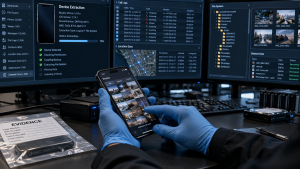
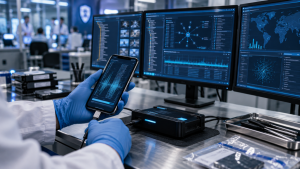
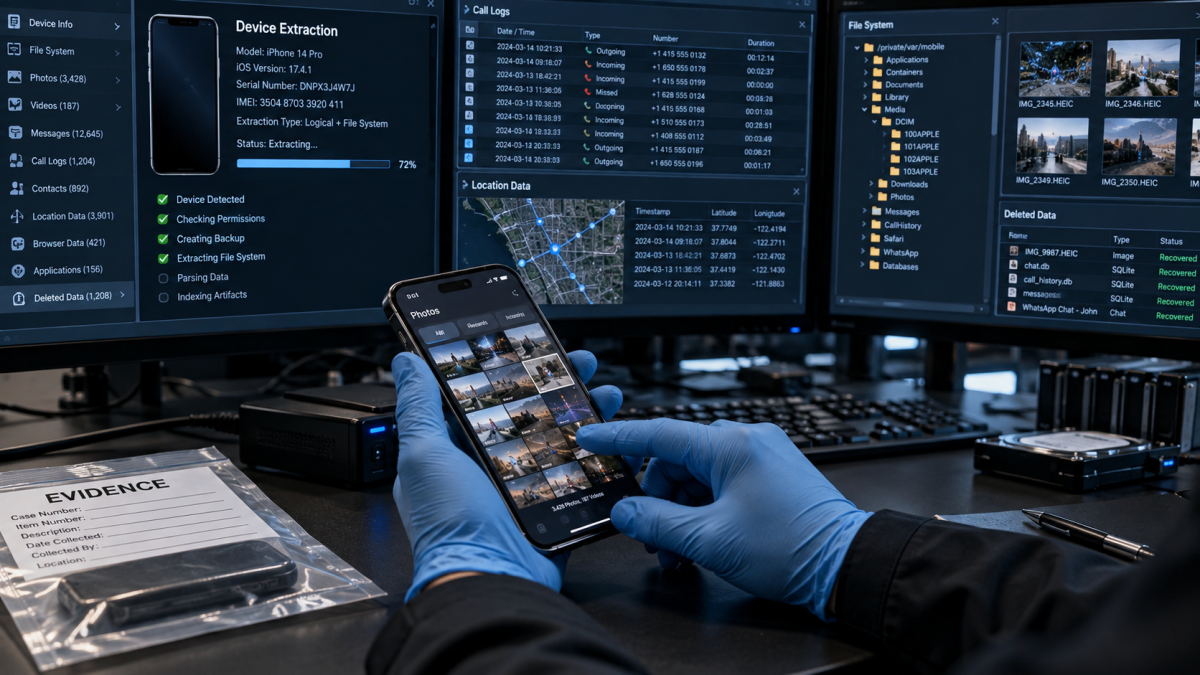
This is where mobile evidence extraction actually happens. Depending on the device, its operating system and its security state, investigators may use one or more of the following methods:
- Logical extraction, which pulls accessible files such as contacts, messages and call logs
- File system extraction, which retrieves system files and app data for a deeper view
- Physical extraction, which creates a bit-by-bit image of the device’s storage, often recovering deleted content
- Chip-off or JTAG methods, used on damaged, locked or heavily encrypted devices where standard extraction is not possible
Choosing the right method requires both technical judgment and up-to-date tools, since manufacturers regularly patch vulnerabilities that older extraction techniques relied on.
3. Data Analysis
Once extracted, the raw data still needs to be made sense of. Analysts sift through call detail records, chat applications, GPS and location history, browser activity, cloud sync artefacts, and even deleted or encrypted files. Advanced platforms can flag cryptocurrency wallets, seed phrases and financial artefacts hidden within a device, which is increasingly relevant in fraud and money laundering investigations.
4. Reporting and Court Presentation
The final step turns technical findings into a clear, structured report that a judge, lawyer or investigating officer can actually use. A credible report documents every tool and method used, preserves hash values to prove data has not been altered, and presents findings in a format that can withstand cross-examination.
Common Challenges in Mobile Forensics
Investigators in India regularly face a few recurring obstacles:
- Encryption and app-level security, especially on modern Android and iOS devices
- Cloud-first storage, where critical evidence lives outside the physical device
- Anti-forensic behaviour, such as factory resets, app locking or the use of disappearing-message platforms
- Device diversity, given the sheer number of manufacturers, models and custom operating systems in use across the country
Overcoming these challenges consistently is what separates a specialist forensic lab from a generalist IT team.
Why Choosing the Right Mobile Forensics Partner Matters
Because mobile evidence often forms the backbone of a case, the quality of the forensic process directly affects whether that evidence is admissible and persuasive in court. Agencies looking for the best mobile forensics company in India should look for a partner with proven government and law enforcement deployments, in-house engineering capability rather than reliance on a single third-party tool, and a track record of building forensic labs and training investigators, not just running extractions.
Pelorus has worked with central agencies, state police forces and defence organisations across the country to set up dedicated cyber and digital forensic labs, train field officers, and deliver mobile device forensic analysis that stands up to scrutiny in real cases. Purpose-built tools such as CaseManager help investigators organise extracted evidence, maintain chain of custody and generate court-ready export bundles, while capabilities like crypto artefact detection support financial and fraud investigations that increasingly begin on a mobile device.
Conclusion
Mobile forensics has moved from a niche technical skill to a core requirement for modern investigations in India. As phones become more secure and data becomes more distributed across apps and the cloud, the gap between amateur data recovery and true forensic-grade mobile evidence extraction only widens. Choosing a partner with proven infrastructure, in-house tools and real deployment experience is no longer optional for agencies and organisations that need results they can trust in court.
If your team needs reliable, court-defensible mobile forensics services in India, get in touch with Pelorus to discuss how our forensic labs, tools and trained experts can support your next investigation.
Frequently Asked Questions
1. What is mobile forensics used for in investigations?
Mobile forensics is used to recover and analyse data such as messages, call logs, location history, photos, app activity and deleted files from a phone to build evidence for criminal, corporate or legal investigations.
2. Can deleted data be recovered from a mobile phone?
In many cases, yes. Physical extraction and chip-off methods can recover deleted messages, files and app data that are not visible through normal use of the phone, though recovery success depends on the device, encryption and how much time has passed.
3. Is data extracted through mobile forensics admissible in court?
Yes, provided it is collected and documented correctly. Maintaining a clear chain of custody, using validated tools and generating a detailed forensic report are what make mobile evidence extraction admissible and defensible in court.
4. How long does a mobile forensic analysis take?
Timelines vary based on the device, its security features and the volume of data. A straightforward extraction may take a few hours, while locked, damaged or heavily encrypted devices can take significantly longer.
5. What types of devices can be examined?
Professional mobile forensics services in India can examine Android and iOS smartphones, feature phones, tablets and, in many cases, damaged or water-affected devices using specialised recovery techniques.
6. How do I choose a reliable mobile forensics company in India?
Look for a provider with proven law enforcement or government deployments, in-house forensic tools rather than dependence on a single vendor, transparent reporting practices and experience presenting findings in court.