
Drones, also known as unmanned aerial vehicles (UAVs), can leave behind a detailed digital trail every time they are used. Flight records, location data, photographs, videos, controller information and data from connected devices can all become relevant during an investigation.
Drone forensics is the process of identifying, preserving, extracting and analysing digital evidence associated with a drone and the systems connected to it. The objective is not simply to recover files from the aircraft. Investigators may need to establish what happened, when and where the drone was operating, how it was controlled and what other evidence is connected to the activity.
What Is Drone Forensics?
Drone forensics is a specialised area of digital forensics focused on examining unmanned aerial systems and the digital evidence they generate.
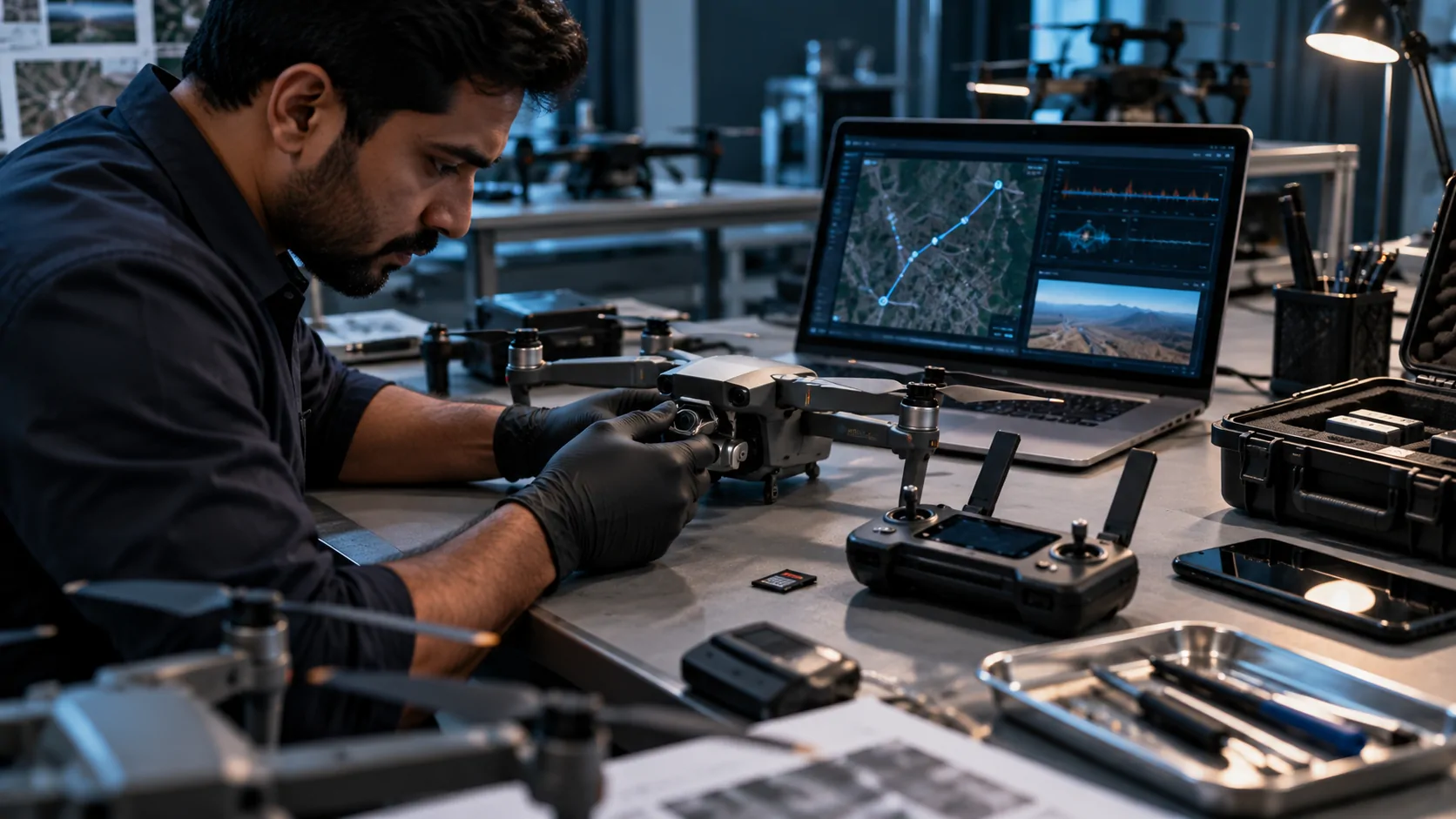
A drone investigation can involve much more than the aircraft itself. Depending on the manufacturer, model and configuration, relevant evidence may be distributed across the drone, remote controller, smartphone or tablet used to operate it, removable storage, flight applications and other connected systems.
The purpose of the examination is to reconstruct relevant activity from available digital evidence while maintaining appropriate procedures for acquisition, examination and reporting.
What Digital Evidence Can Be Found in a Drone Investigation?
The type and amount of evidence available varies between UAVs, but investigators may encounter several important categories of digital artefacts:
- Flight logs and telemetry data
- GPS coordinates and flight paths
- Altitude, speed and heading information
- Take-off and landing information
- Photographs and video recordings
- Media metadata
- Controller and device identifiers
- Companion application data
- Memory card and onboard storage data
- Mission or waypoint information
These artefacts should not be treated as identical across all drones. Manufacturers, models, firmware versions and storage architectures can affect what information is created, where it is stored and whether it can be recovered.
Where Do Investigators Look for Drone Evidence?
One of the most important aspects of drone forensics is understanding the complete evidence environment rather than examining the aircraft in isolation.
The Drone
The UAV itself may contain flight-related information, system data, photographs, videos and other artefacts. Depending on the design, information may be stored in internal memory, removable media or other components.
The Remote Controller
The controller may contain operational records, configuration information, identifiers or other data associated with communication between the controller and aircraft. This evidence can complement information recovered from the UAV.
The Paired Smartphone or Tablet
Many drones are operated through a mobile application. The paired smartphone or tablet may therefore contain flight information, application data, photographs, account information and other artefacts connected with the operation of the drone.
Examining this device alongside the UAV can provide additional context that may not be available from the aircraft itself.
Removable Storage and Other Systems
SD cards and other removable media may contain photographs, videos, flight logs and related files. Investigators may also need to consider computers, ground control systems and other devices associated with the UAV.
How Does a Drone Forensic Investigation Work?
A defensible examination requires a structured forensic workflow. The exact approach depends on the device and circumstances of the investigation, but several stages are generally important.
1. Secure and Document the Evidence
Investigators first secure the recovered UAV and associated equipment and document their condition. Relevant accessories, storage media and connected devices should also be identified before examination begins.
2. Identify Potential Evidence Sources
The investigation should establish which components may contain relevant information. Looking beyond the aircraft early in the process can prevent important evidence from being overlooked.
3. Acquire the Digital Evidence
Forensic acquisition involves obtaining relevant data using appropriate methods while preserving the integrity of the original evidence. The acquisition technique depends on the hardware, storage architecture, device state and available forensic capabilities.
4. Examine and Decode the Data
After acquisition, investigators examine flight logs, telemetry, media, metadata, application artefacts and other available information. Proprietary file formats can make this stage challenging, particularly when dealing with different manufacturers, models or firmware versions.
5. Correlate the Evidence
The value of individual artefacts often increases when they are examined together. For example, a flight log may show that a UAV was operating at a particular location and time, while a photograph and paired smartphone may provide additional information relating to the same activity.
Correlating these sources can help investigators determine whether they support a consistent timeline.
6. Reconstruct and Report the Relevant Activity
Once the available evidence has been analysed and correlated, investigators can reconstruct relevant activity within the scope of the investigation. Findings should be documented clearly, including the evidence examined, methods used, observations and limitations.
Why Evidence Correlation Matters in Drone Forensics
A single drone artefact rarely provides the complete investigative picture. A flight log may establish movement, while GPS information can provide location context and recorded media can show what the UAV captured.
When these sources are considered together, investigators may be able to establish stronger connections between the aircraft, its operation and other relevant activity.
This multi-source approach is particularly important when the investigation involves several devices or when one evidence source does not provide enough context on its own.
Key Challenges in Drone Forensics
Drone investigations can present technical challenges that require specialised forensic knowledge.
- Device variation: Different manufacturers and models can store and expose different types of data.
- Proprietary formats: Some systems use specialised data formats that require appropriate forensic tools or decoding capabilities.
- Encryption and access restrictions: Security controls can limit access to available evidence.
- Firmware changes: Updates can change how information is stored or accessed.
- Deleted data: Recovery of deleted information depends on factors such as the storage medium, subsequent device use and overwriting.
- Tool validation: Forensic tools should be appropriately tested and validated before their results are relied upon in an investigation.
- Evidence integrity: Acquisition, examination, storage and reporting must be properly documented.
Drone Forensics in Law Enforcement Investigations
Law enforcement agencies may encounter drones in investigations involving unauthorised surveillance, restricted-area activity, smuggling, accidents, criminal operations and other incidents.
Forensic examination can help investigators understand how a UAV was used and what digital evidence it generated. Depending on the case, this evidence may then be considered alongside information from smartphones, computers, storage media and other digital systems.
This makes drone examination part of a broader digital forensics workflow rather than an isolated technical exercise.
How Drone Forensics Fits Into a Broader Digital Investigation
A UAV may be only one component of a larger investigation. A case could involve the drone itself, its controller, a smartphone used to operate it, a computer containing related files and communications between individuals.
Examining these sources together can reveal relationships that may not be visible when each device is analysed independently.
Pelorus supports digital investigations across multiple evidence environments through its investigation services. For investigations involving multiple evidence sources and large volumes of information, Pelorus CaseManager provides a structured environment for managing cases, evidence and intelligence.
Frequently Asked Questions About Drone Forensics
What is drone forensics?
Drone forensics is the forensic examination of data generated or stored by a UAV and its associated devices. Depending on the system, this may include flight logs, telemetry, GPS data, photographs, videos, controller information, application data and storage media.
What data can be recovered from a drone?
Potential evidence includes flight logs, GPS coordinates, telemetry, photographs, videos, metadata, device information and other operational artefacts. The available data depends on the manufacturer, model, firmware and storage architecture.
Can drone forensics identify the operator?
Drone evidence may help establish connections between the UAV, controller, paired mobile device and other digital artefacts. Whether an operator can be identified depends on the evidence available and the circumstances of the investigation.
Can deleted drone data be recovered?
Deleted data may sometimes be recoverable, but there is no universal guarantee. Recoverability depends on the storage medium, subsequent use, overwriting, file-system behaviour and the acquisition method used.
Why is the drone controller important?
The controller can contain information that complements evidence recovered from the aircraft. Depending on the system, it may provide operational records, identifiers or other artefacts that help investigators correlate the UAV with a particular flight or device.
Conclusion
Drone forensics can turn a recovered UAV into a valuable source of digital evidence. Flight logs, GPS information, telemetry, photographs, videos, controller records, mobile application data and storage media can each contribute to an investigation.
The strongest findings often emerge when these sources are examined together and placed within a documented forensic workflow. Because UAV architectures, firmware, data formats and available artefacts can vary significantly, effective examination requires appropriate tools, technical expertise, evidence preservation and careful interpretation.
Pelorus supports digital forensic investigations with technologies and expertise that help investigators acquire, analyse and interpret digital evidence across different sources and devices. For agencies dealing with UAV-related incidents or broader digital investigations, this approach can help turn fragmented digital artefacts into structured investigative intelligence.
Explore Your Drone Evidence Workflow
Have a UAV, controller or connected device that may contain relevant digital evidence? Discuss your investigation requirements with Pelorus to understand how drone-related evidence can be examined and correlated within a broader forensic workflow.