
CCTV footage can become important evidence in criminal investigations, security incidents, fraud cases, workplace investigations and other disputes. However, recovering that footage is not always as simple as opening a recording and copying a video file.
Digital Video Recorders (DVRs) can store surveillance footage in proprietary formats and structures that ordinary computers may not recognise. Incorrect export methods can also result in the loss of metadata, reduced quality or incomplete evidence.
DVR forensics is the process of acquiring, recovering, preserving and analysing digital video evidence from DVR-based surveillance systems while maintaining its integrity and context.
What Is DVR Forensics?
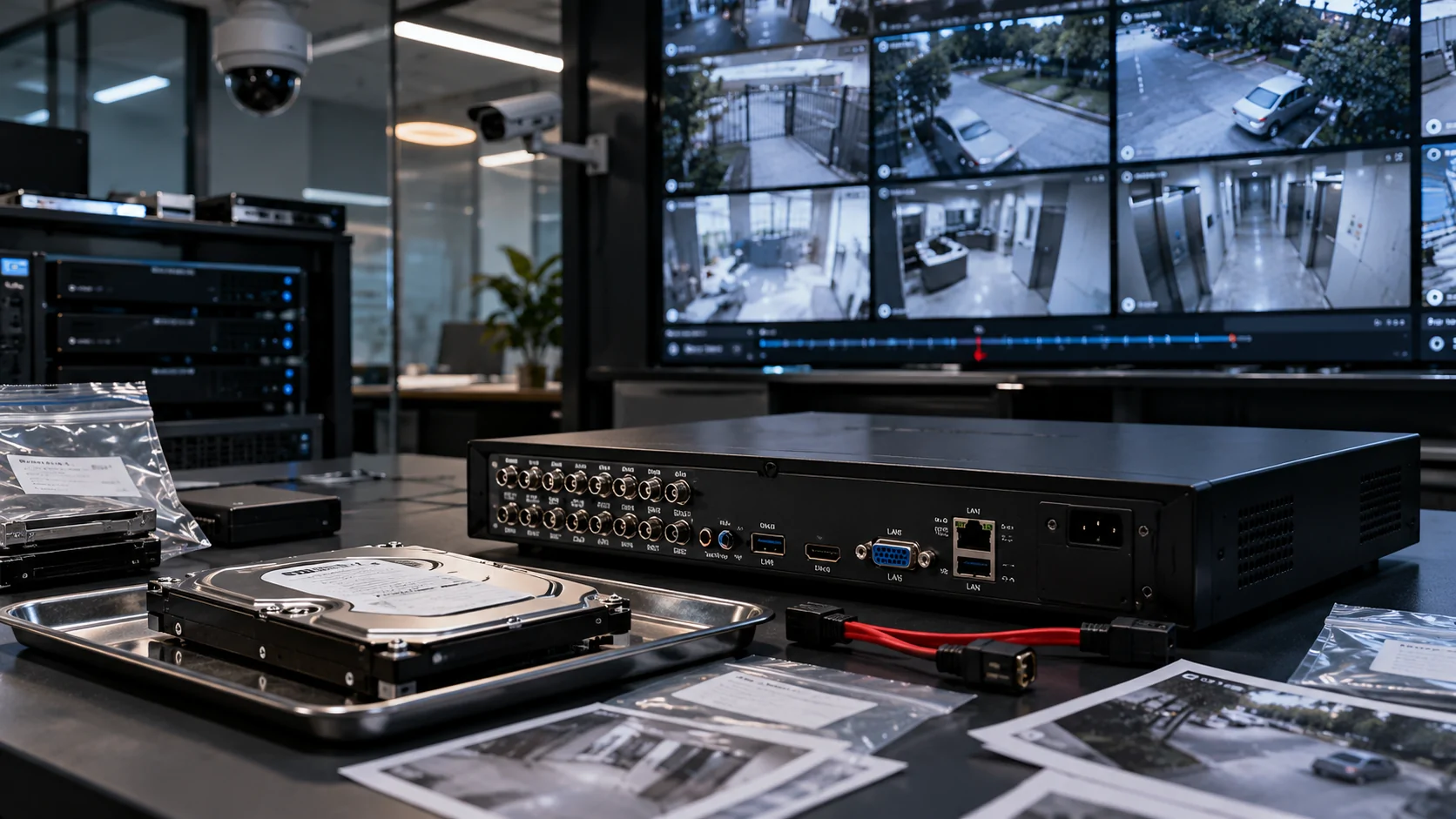
DVR forensics involves the forensic examination and recovery of video, audio and associated data stored by Digital Video Recorders used in CCTV systems.
Depending on the system, a DVR may contain recorded footage, timestamps, camera identifiers, recording settings, motion events, system logs and other information. The exact evidence available varies between manufacturers, models and system configurations.
Because different DVRs can use proprietary storage and export formats, forensic recovery may require specialised tools and methods rather than conventional video playback software.
Why Does CCTV Evidence Require Forensic Recovery?
For investigators, the objective is not simply to obtain a playable video. They also need to establish where the recording came from, which camera and DVR produced it, what time period it represents and how the evidence was acquired.
Important considerations include:
- DVR manufacturer and model
- Connected cameras and recording configuration
- System date and time
- Original recording format
- Available metadata and system information
- Condition of the storage medium
- Acquisition and preservation method
A documented forensic process helps maintain the integrity and context of the recovered evidence.
How Investigators Recover Evidence From a DVR
1. Identify and Document the CCTV System
Investigators first document the DVR, connected cameras, storage media, recording configuration and other relevant system information. The DVR's displayed time should also be compared with a reliable time reference because the system clock may not reflect actual time.
2. Identify Relevant Footage
The investigation should establish the incident, time period and camera channels that are relevant. Defining the scope early can reduce unnecessary processing while ensuring important footage is preserved before it is overwritten.
3. Preserve the Original Evidence
Many DVRs continuously record and overwrite older footage when storage capacity is reached. Delaying preservation can therefore reduce the possibility of recovering relevant recordings.
The acquisition method should be selected carefully to preserve the best available quality and associated information without unnecessarily altering the original evidence.
4. Acquire Native or Proprietary Data Where Possible
DVR systems may store recordings in proprietary formats or structures. Converting footage directly into a standard format such as MP4 can result in information being lost.
Where practical, investigators should preserve the native or proprietary evidence and create suitable working copies for examination or presentation.
5. Verify Working Copies
After acquisition, investigators can create working copies while keeping the master evidence separately preserved. Hashing can help verify that evidence has not changed during subsequent examination.
6. Examine the Recovered Footage
The examination may involve reviewing relevant camera channels, identifying important sequences, examining individual frames and reconstructing activity around the incident. The exact analysis depends on the investigative question.
What Evidence Can Be Recovered From CCTV DVRs?
Depending on the recorder, storage condition and acquisition method, investigators may recover:
- Recorded video footage
- Audio where supported
- Camera channel information
- Recording timestamps
- Frame and video properties
- Motion or alarm events
- System logs
- Recording configuration information
- Associated metadata
Not every DVR will contain all of these elements. The available evidence depends on the particular system and what remains accessible.
Can Deleted CCTV Footage Be Recovered?
Deleted or inaccessible CCTV footage may sometimes be recoverable, but recovery is not guaranteed.
The possibility depends on how the DVR stores data, whether relevant sectors have been overwritten, the condition of the storage medium and whether the recording indexes or file structures remain usable.
Continuous recording is particularly important because older footage may be overwritten by newer recordings. If normal export is unavailable or the DVR is damaged, investigators may need to examine the underlying storage using a forensic recovery process.
Why Do DVR Timestamps Matter?
A timestamp displayed on CCTV footage should not automatically be treated as the exact real-world time. DVR clocks can be incorrectly configured or differ from actual time.
Investigators may therefore need to document the system time and compare it with a reliable reference when reconstructing an event. This becomes particularly important when CCTV is correlated with mobile device activity, communication records, access-control systems or other evidence.
DVR Forensics and Evidence Integrity
Evidence integrity is central to forensic CCTV recovery. Investigators should document what evidence was received, how it was acquired, where it was stored and what examination was performed.
Maintaining appropriate continuity and documentation from the original recording through the working copy and final report helps create a defensible forensic record.
The objective is not simply to obtain a video file. It is to preserve the evidence and document the process used to recover and analyse it.
How Is Recovered CCTV Evidence Analysed?
Recovery is only the first stage. Investigators may then analyse the footage to answer specific questions about an incident.
This can include:
- Reviewing footage from multiple cameras
- Reconstructing an event timeline
- Examining relevant frames or sequences
- Identifying people or vehicles where the footage permits
- Comparing activity across camera locations
- Assessing video quality and recording characteristics
Forensic video analysis goes beyond simply watching a recording. The examination should be guided by the investigative question and documented appropriately.
Correlating CCTV With Other Digital Evidence
CCTV evidence can become more valuable when examined alongside independent evidence sources.
Investigators may compare CCTV timestamps and events with:
- Mobile device evidence
- Call and communication records
- Access-control logs
- Vehicle records
- Location information
- Digital photographs or videos
Comparing these sources can help investigators test timelines, identify inconsistencies and establish whether different evidence supports the same sequence of events.
This forms part of a broader digital forensics workflow, where evidence from different digital sources can be examined and correlated.
Why Specialist DVR Forensic Analysis Matters
CCTV systems vary significantly between manufacturers and models. Proprietary formats, damaged storage, inaccessible indexes and different recording architectures can make evidence recovery technically challenging.
Specialist forensic analysis can help investigators select an appropriate acquisition method, preserve relevant evidence, interpret recording structures and create documented working copies for examination.
For organisations handling complex investigations, DVR examination can form part of a wider digital investigation workflow. Pelorus also provides CaseManager for organising cases, evidence and investigative information.
Frequently Asked Questions About DVR Forensics
What is DVR forensics?
DVR forensics is the forensic acquisition, recovery, preservation and analysis of video and associated data stored by Digital Video Recorders used in CCTV systems.
Can deleted CCTV footage be recovered?
Sometimes. Recovery depends on factors such as overwriting, storage condition, DVR architecture and the state of the underlying data. Recovery cannot be guaranteed.
Why is the native DVR format important?
Native or proprietary data may contain information that can be lost when footage is converted to a standard video format. Preserving the original data can therefore be important for forensic examination.
Can CCTV footage be used as digital evidence?
CCTV footage can potentially form part of digital evidence, but its evidentiary value depends on how it was acquired, preserved, documented and analysed, as well as the applicable legal and procedural requirements.
Why should investigators check the DVR timestamp?
The DVR clock may not match actual time. Comparing the system time with a reliable reference can help investigators reconstruct a more accurate timeline.
Conclusion
DVR forensics is about much more than copying CCTV footage. Investigators need to understand the recording system, identify relevant footage, preserve the original evidence and select an appropriate recovery and acquisition method.
Proprietary formats, timestamp differences, continuous overwriting and damaged storage can make CCTV evidence recovery technically challenging. A structured forensic approach helps investigators preserve the best available evidence while maintaining its context and integrity.
When CCTV evidence is correlated with mobile, communication, location and other digital evidence, it can become an important part of a wider investigation and help reconstruct events from multiple sources.
Pelorus supports digital forensic investigations through technologies and expertise that help investigators examine and correlate evidence from different digital sources.
Discuss Your Digital Investigation Workflow
Need to recover or analyse CCTV evidence from a DVR system? Speak with Pelorus about your digital investigation requirements and forensic evidence workflow.